
Museo esittelee erityisesti vapa- ja viehekalastuksen kehitystä, unohtamatta kuitenkaan elinkeinokalastuksen historiaa nykyisen vapaa-ajankalastuksen taustalla. Perusnäyttely kertoo vanhasta Päijät-Hämeen pyyntikulttuurista, viehekalastuksen ja vapapyynnin eri menetelmien sekä onkilaitteiden ja uistinten kehityksestä. Näyttely etenee teemallisesti kohti päijäthämäläisen uistimen suurta menestystarinaa, jonka luojia ovat mm. tuotenimet Rapala, Nils Master ja LGH. Uudistetut näyttelyt esittelevät myös amerikkalaisen unelman, Normark-yhtiön syntyä ja edistyksellistä tuotekehitystä sekä erakko Pylväläisen tarinan.
Explore both nature and fishing history from prehistoric ages till today. The exhibitions present the development of both recreational and professional fishing in the area through the centuries. The thematic collections depict the famous story of the local lure creators, e.g. Rapala, Nils Master and LGH amongst others. Find out yourself by visiting our museum. Updated collections and exhibitions now on show!
The collections and exhibitions have been established by the Finnish Fishing Museum Association. The fishing museum is subsidized by Asikkala municipality and professionally maintained. It is supported by the Finnish Recreational Fishing Museum Foundation, established by Ensio Rapala in 2001 for the purpose of recording and cherishing Finnish fishing history and traditions to develop the museum functions.
For our international visitors we have translated all the information about our exhibitions here, following the visitor route described in our museum floor plan.
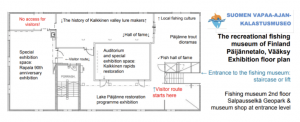
We welcome you to explore the exhibitions of our fishing museum! Pls follow the marked visitor route of the floor plan and the various sections of the exhibitions described here. When you enter the 2nd floor, first on your left you see an example of traditional trawling net used for catching vendace that is typical to Finnish waterways. Just in front of you on the opposite wall to the stairs, you see the Fish Hall of Fame, namely 20 regular fish species living in the Lake Päijänne waterways, illustrated by colour drawings and described by poems. Next on your right you see the Päijänne trout dioramas and examples of local fishing traditions. On the left you enter in our main exhibition of Kalkkinen lure valley makers, to dip deeper into the local lure making world that is a unique part of the local fishing history that cannot be found anywhere else. In this section you will find the Hall of Fame with honoured personalities of the Finnish tackle industry and fishery trade described in detail.
In our special exhibition for 2026 we are celebrating the 90th anniversary of Rapala lures – beware to be amazed!
In the last part of the fishing museum, you will find the master plan of the Lake Päijänne restoration programme, including the two local restoration projects, the Kalkkinen rapids (auditorium) and the Virtaankoski rapids in more detail.
The Kalkkinen lure valley wobbler makers
At the roots of the lure making in Päijät-Häme region – the story of Pylväläinen
The legend around the famous lure from Päijät-Häme was built not only on Rapala but also on the work of Toivo Pylväläinen and other local lure makers. Like Rapala, the beginning of the narrative of also other lure makers in the Lake Päijänne area well depicts the livelihood of the poorly people – those people who would professionally fish for income on the shores of Finnish lake district in the beginning of the 1900’s. In Päijät-Häme region these people also started to sell their lures along the fish catches, and that’s where the great success story originates from, among those various cottage industry crofters.
”The Lake Päijänne hermit” and ”Kaiser of Koreakoivu”, Toivo Pylväläinen was born in Leivonmäki (on the eastern bank of Lake Päijänne) in 1894. He resided in various locations working as a lumberjack or foreman in the forestry trade before moving to Lake Päijänne, the island of Koreakoivu (Harhu) situated on its vastest open water called Tehinselkä in 1936. The island stands at a triangle of three municipalities in the middle of the lake. Already before that he often fished on the lake from the shores of Padasjoki village, from where it was easy to access those waters, in the beginning of the 1930’s.
When Pylväläinen’s and Rapala’s lures started to gain fame, also other local crofters started lure making. During the 1930’s the most well-known local lure makers were many, among those: Akseli Soramäki, Yrjö Siljander, Väinö Kivinen as well as the brothers Urpo and Uuno Laaksonen. When the lure making became more industrialized, many others joined the lure league, following the development of marketing. Unto Saarinen’s Päijänne lure started in the beginning of the 1950’s and already sold his lures to America during the 1960’s, along with Rapala. Arvi Rouhiainen established his Finn-R lure that continued its operation till the 1980’s. Väinö Koistinen’s boat building company’s VKV lures and Reino Suontausta’s lures were also shipped to the American market at the highest boom in the 1960’s. All of these, well-proven brands gradually faded away in the hard trade competition.
Picture: Pylväläinen’s lure model was patented in the 1960’s and ended up in the Finn-R production programme. It was also marketed to the Soviet Union at that era.
LGH lure – a genuine pearl of the cottage industry
Picture: Leo Gunnar finishing his lures with his wife – bound to catch fish.
Leo Gunnar Hacklin started his lure making for sales in Kalkkinen village around 1949. Already in the 1950’s he exported them to Sweden and Canada. More was wanted for the American market, but since Hacklin’s aim was to produce handmade lures with precision quality, he did not want to mass scale the production. That’s why the LGH has been mainly sold for the domestic market. One of the guarantees of quality has been the careful finish of the tin foil. The lure is extremely light but durable – and specially appreciated by trout. The production of LGH was continued by Leo Gunnar Hacklin till he sold the operation to Tapani Ahonen and eventually both the production and the sales has been operated by Jarmo Rapala and his son.
Picture: a thank you -letter from President Urho Kekkonen
Leo Gunnar Hacklin developed a lure in Riihilahti, Kalkkinen village of Asikkala municipality that ever since has gained a legendary reputation among the sports fishermen. The most important feature in the making of LGH lure is the swimming action that entices a suspicious salmonoid into aggressive strike – that’s why each lure is carefully tuned. This is possible only when the production scale is limited and that’s why the LGH lures are finished only after tens of production phases. The production technique has remained the same for more than 40 years; the lure is made totally by hand – except the lathing of the lure body. The users of LGH lure are devoted fishing amateurs, of whom one of the most famous was the late President Kekkonen. Leo Gunnar has worked closely with our production team.
Tight lines!
Producer Tapani Ahonen
Finlandia-Uistin – the creator of classic lures
Finlandia-Uistin started its operation in Kalkkinen village in 1963, when the brothers Hannu and Kalevi Kangas started dreaming about access to the United States market with their basic Päijät-Häme lure type. The brothers had previous experience in lure making in their brother-in-law’s Päijänne lure production under the wings of Unto Saarinen. The business started by a big order from America. When the market was filled with the basic model sold by the importer of Finlandia-Uistin, they were faced by renewing the selection.
After various tests, the brothers developed a revolutionary new wobbler series that diverges from the early models by their shape, as well as by their rich colours. It was in 1966 when the tail waggling lure, Invincible and a new brand name, Nils Master saw the light. The foreign markets have expanded as far as Australia and therefore the company employs around 20 workers at their factory. All this is thanks to strong export promotion. The famous Nils Master lure selection included a Swedish Bete brand in their programme in 1978, originally developed by Tage Tysklind in the 1940’s.
The Rapala story and its early phases of production
Picture: The Lyyranmäki cottage in the early 1930’s
Lauri Rapala was born in the Rapala village of Sysmä municipality in 1905. His mother Maria moved with her 5-year-old son to Asikkala to work as a maid and net-mender in the Tommola farm in the Särkijärvi village of Asikkala municipality. When the young and lovely Elma Leppänen arrived at the farm starting to mind their children, it was evident for Lauri that in her he will find his future spouse. Lauri and Elma soon married and moved to Riihilahti to dwell in the small Leppänen crofter’s cottage in 1928, along with Elma’s parents. A few years thereafter the growing family moved nearby in the one-room Lyyranmäki cottage as lodgers in 1933. After the II WW they managed to buy this cottage and even build a new house on the site for the growing family. Their children, Reino, Risto, Ensio, Esko, Kauko, Marja and Irja were born one after another in these modest conditions during 1929-52. To feed them all, Lauri and Elma made their living working in the farms and forests on seasonal basis and during the times of shortage professional fishing was helping to make the ends meet. Lauri used a thousand-hooks longline to catch as many fish as possible for selling them on the market. When the idea of a Finnish wobbler evolved, there was less time for actual fishing and lure making became the main income of this resilient family during those hard times.
Lauri Rapala made his first and famous lure in 1936. It was a floating, golden-coloured vendace imitation with a cork body. The experiences of catching fish with baits and the impressions of American wooden lures fed his idea of an endurable and enticing trout lure. In addition to these, the tests that Toivo Pylväläinen had made, steered Lauri’s attempts regarding the development of the model and its finish, which they both made side by side.
Picture: Lauri Rapala and Toivo Pylväläinen – the creators of the Päijät-Häme wobblers
A larger scale production of Rapala lures was planned to be started already in the 1930’s, but since the war broke in between, it was postponed till the end of the 1940’s, when the actual serial production had a kickstart in the enlarged cottage spaces. The pace was accelerated by nominations and prizes in the local agricultural fairs, as well as the prominent experiences by the Kalkkinen rapids sports fishermen’s club. The lure making started to make more profit, when the Helsinki based shopkeeper Fritz Schröder ordered Rapala lures for sales throughout Finland and the Nordic countries in the beginning of the 1950’s. Production was increased, more space was acquired in 1953, and the local people were recruited to gather pine bark and shape lure bodies – since in those days pine bark era ruled. When starting the serial production, the working process was enhanced with the help of band saw and circular saw.
The Rapala success story
The great Rapala success story was created by exports. In the beginning the lures were exported to Sweden. Lauri Rapala and his sons established a company called Rapala-Uistin in 1957. That year while they visited Sweden, they were faced by a distribution scheme that spared no means; the Swedish distributor had registered the Rapala brand for themselves and started making their own Super-Rapala for the Swedish market. However, they ended up in making a deal, which was compensated by their first lathing machine, helping them to produce the lure bodies much faster. This machine for its part symbolizes a shift from the old cottage industry into the new industrial production and bigger markets’ hum.
The lathing machine became essential when the U.S. market opened with significant demand. Rapala wobblers swam to the United States already during the 1950’s and therefore it was evident that Ron Weber, a salesman and avid fisherman could get his hands on them, and with his mate Ray Ostrom, a local fishing tackle dealer they were able to place a more substantial order in 1959. This American marketing company, Normark that they established together, started soon placing even bigger orders. Good business relations were a foundation to the success, but Rapala’s market was exploded by the sudden death of a historical person. In 1962 the Life magazine run an article both about Rapala lures – a lure fish can’t pass up – as well as the sensational report on Marilyn Monroe’s death. Fishermen started to grab Rapala lures in a quicker pace…
Picture: The Rapala factory was enlarged in 1965, and bigger transportation vehicles were acquired.
Production and models develop
Along with the success of the marketing, also the Rapala production and models were developed in a successful manner, maintaining the product quality continuously on a high level. As the markets enlarged, also the production capacity was increased and renewed at the same pace. A new factory was built in Vääksy in 1962 and in Riihilahti another facility the next year. In 1972 Rapala celebrated the opening of a new and even bigger factory in Vääksy, on the present site, where the production was concentrated for decades to come. But that was not the end of the enlarging era, since in 1980 Rapala opened a new factory in Ireland, followed by another facility in Estonia since 1997, where most of the production still takes place.
Picture: The inauguration of the new factory in Inverin, Ireland; (from the right) M.D. Lars Ollberg, Irish government representatives and Ensio Rapala.
The company form was changed into Rapala Oy (limited company), till it was consolidated into Normark that had evolved into a global marketing giant that had already sold more than 200 million Rapala lures at the beginning of the new millennium. Lauri Rapala, who originally was a modest crofter and professional fisherman, was granted the honorary title, economic counsellor, for his lifetime achievements, dies in 1974. His sons and grandchildren continued his mission working in the family company that later employed more than 2000 people in nearly 40 countries, being the biggest lure producer in the world.
Picture: Work phases from the 1960-70’s, when the production growth was the fastest.
At the other end of the hall you are greeted by Marilyn Monroe in her famous pose from a movie scene. Next to it, there’s a replica of Lauri Rapala’s crofter’s cottage, where the magic of lures took place, along with the rest of daily life of a growing family. This section has been carefully set up by Ensio Rapala himself with original family objects. Incidentally, a similar room has been built in the National Fresh Water Hall of Fame in Hayward, Wisconsin, U.S.A. in memory of Lauri Rapala’s lifetime legacy by the financial support of Ensio Rapala and designed by Sirpa Glad-Staf.
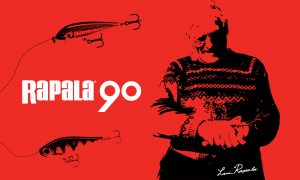
IN SUMMER 2026 WE CELEBRATE THE 90TH ANNIVERSARY OF THE RAPALA LURE
From a Finnish lake to a global legend: for 90 years, Rapala has been part of how the world fishes. Starting with Lauri Rapala hand-carving lures from cork on the shores of Lake Päijänne, the brand grew from a Finnish lakeside workshop into one of the most recognised names in fishing. This exhibition celebrates that journey and invites the whole family along for it.
Explore original lure designs, discover the craft behind the classics, and see how Rapala continues to push fishing forward from the drawing board to the world’s biggest waters. For the kids, there’s a dedicated gaming corner and a design-your-own-lure station where the winning design will actually turn into a real lure.
90 years in the making. Come see what’s next. Open for public from 15.6.2026. Basic exhibitions will continue and develop on yearly basis, so please drop in as often as you like!
Thank you for your attention – we hope you like our exhibitions! Looking forward to seeing you again!


